
Lafayette County Court Records After Arrest
A jail arrest is a custody event. A court record is the case file that follows once a charge is filed, reviewed, amended, dismissed, or resolved. In Lafayette County, early matters may involve Justice Court or County Court. Felony prosecutions move through Circuit Court and the Third Circuit District Attorney. The Circuit Court page says Circuit Courts hear felony criminal prosecutions and appeals from County, Justice, and Municipal courts.
For the custody side, use Lafayette County jail inmate records. For booking photos, use Lafayette County jail mugshots. Court records after a jail arrest focus on the filed case: complaint, indictment, bond order, warrant, hearing, plea, dismissal, or final disposition.
Find Court Records After Arrest
The county research points to two court-search paths. Delta Computer Systems provides a public Lafayette Circuit/County criminal search, but its page says Circuit/County Court record updates end February 26, 2024, and access to documents is pay per document at $0.50 per page. Mississippi Electronic Courts also matters because Lafayette Circuit and County civil and criminal filings were approved for MEC use.
- Start with the person's full name, booking date, charge, or case number if known.
- Search the Delta Computer Systems Lafayette criminal court page for accessible Circuit/County records.
- Use Mississippi Electronic Courts for current e-filed Lafayette Circuit and County matters where access applies.
- Call or visit the proper clerk when the online result is incomplete, outdated, sealed, or not yet filed.
- Contact the jail only for custody or booking status, not as the final source for prosecutor-filed charges.
The Delta search page is useful, but the posted cutoff means it should not be treated as the only current source for court records after an arrest.
Lafayette County Court Search Fields
The Delta criminal court search has a broad field set. The page says to enter information into one field and click submit. Refinements can apply to name searches, including filing date ranges and case type.
| Field Label | Type | Required | Notes |
|---|---|---|---|
| Party Name Name (Last, First) | Text | One field required | Name format is shown as Last, First. |
| Case Number | Text | One field required | Best when the clerk or court notice gives a case number. |
| Filed Date | Date | One field required | Search by filing date. |
| Final Disposition Date | Date | One field required | Search by final result date. |
| Styled Defendant | Text | One field required | Useful when party styling is known. |
| Case Type | Refinement | Optional | All, Civil, or Criminal. |
The Delta search page shows the Lafayette criminal court query fields and document fee notice.
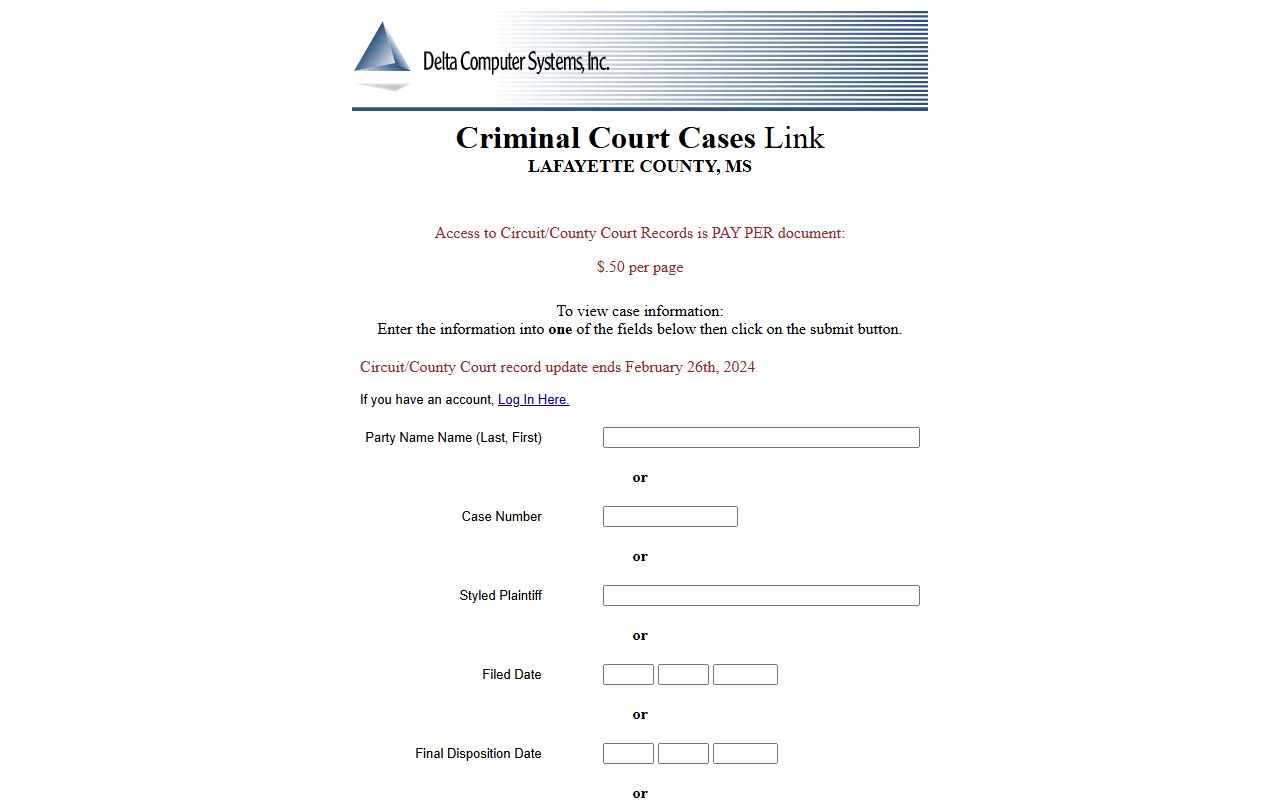
Use Delta for the records it covers, then check MEC or the clerk for newer case activity.
Charges Filed After Arrest
Jail booking charges are not always the final court charges. The prosecutor may pursue, amend, dismiss, or present charges to a grand jury. The Third Circuit District Attorney serves Lafayette County and the DA materials define key terms such as complaint, indictment, preliminary hearing, plea, and disposition.
| Document | What It Means | Lafayette County Context |
|---|---|---|
| Complaint | Legal instrument that starts a criminal action. | May be tied to early filing or lower-court action. |
| Information | Prosecutor-filed charge document where allowed. | Use clerk or prosecutor sources for filed status. |
| Indictment | Written felony charge voted or filed by a grand jury. | Felony matters belong in Circuit Court after indictment or filing. |
Lafayette County Arrest Court Path
Justice Court is often important right after arrest. The Justice Court page says it handles felony charges from Oxford, Lafayette County, and the University of Mississippi, plus misdemeanors, traffic tickets, and lower-value civil matters. County Court became effective January 1, 2023 after the county reached 50,000 population in the 2020 Census. The County Court page says it may issue search warrants, set bonds, conduct preliminary hearings, and hear appeals from Justice and Municipal courts.
Felony prosecution belongs to Circuit Court and the Third Circuit District Attorney's Oxford office. The DA contact page lists the Oxford office at 300 North Lamar Blvd., Suite 207, Oxford, MS 38655, phone (662) 234-3304. The Circuit Clerk, Jeff Busby, is the county contact for Circuit Court records at 1 Courthouse Square, Suite 101, Oxford, phone (662) 234-4951.
Lafayette County Charge Status
Charge status can change after arrest. A charge may be pending, amended, reduced, dismissed, moved to a different court, or resolved by plea or trial. A dismissal means the charge is removed by the court. A disposition is the final case result, such as conviction, dismissal, or acquittal. A bench warrant can appear when a person misses court.
| Status | What It Means |
|---|---|
| Pending | The charge or case is still active and no final result is shown. |
| Amended or reduced | The filed charge changed from the original arrest or complaint language. |
| Dismissed | The court removed the charge, but related records may still need expungement or sealing action. |
| Convicted | A guilty plea or trial result created a conviction record. |
| Bench warrant | A judge issued a warrant, often for failure to appear. |
Bond After Lafayette County Arrest
Bond information is spread across the courts. County Court may set bonds. Justice Court handles lower-court and early felony-charge categories. Circuit Court handles felony prosecutions. The DA glossary defines bail as money or bond posted as collateral to ensure a future court appearance, and own recognizance as release without posting bail when the court finds the person likely to appear.
| Bond Type | How It Works |
|---|---|
| Cash bond or bail | Money posted as collateral for court appearance. |
| Surety bond | A bail agent or surety posts bond; verify the court and jail requirements first. |
| Own recognizance | Release without posting money when the court allows it. |
| No-bond hold | The person remains in custody until a court or holding agency changes status. |
| Detainer or hold | Another agency or jurisdiction can block release even when a local bond exists. |
Warrants After Lafayette County Arrest
No official Lafayette County active-warrant web search was found on the county or sheriff pages reviewed. Warrant checks therefore use the sheriff, courts, Delta/MEC records, and public-records channels. County Court may issue search warrants. Justice Court and Circuit Court records can show bench warrants or failure-to-appear activity after a case starts.
Ask about the issuing court, charge or offense, case number, warrant date, bond or no-bond status, and whether the warrant has been served. Do not treat an absence from a web search as proof that no warrant exists.
Charges vs Convictions
A charge is an accusation. A conviction is a guilty finding by plea or trial. Court records after a jail arrest can show both, but they should not be read as the same thing.
| Charge | Conviction | |
|---|---|---|
| Stage | Accusation or filed count. | Final guilty result by plea or trial. |
| Can Change | Yes, it may be amended, reduced, or dismissed. | Changes usually require later court action. |
| Use | Shows what was alleged after arrest. | Shows a final criminal-history result. |
Sealed vs Expunged Records
Research did not locate a direct official Mississippi expunction code page during this pass, so expungement should be discussed generally. A dismissed charge or eligible disposition may still appear in court records until a court orders sealing, expungement, or another form of restricted access. The clerk cannot treat a record as cleared just because a person says the case was dropped.
| Sealed | Expunged | |
|---|---|---|
| Public visibility | Hidden from ordinary public view. | Cleared or treated as removed under the court order. |
| Who acts | Court order controls access. | Court order controls removal or restriction. |
| Proof needed | Case number and order details. | Case number, disposition, and signed order details. |
Restricted Lafayette County Court Records
Public access has limits. Juvenile matters, sealed records, some mental-health and substance-abuse commitments, and investigative law-enforcement materials may be restricted. The Public Records Act broadly covers public records, including photographs and records retained for public business, but law-enforcement exemptions and redactions still apply. Court records can also be limited by court order.
Important: Casual court searches are not FCRA background checks and should not be used for employment, housing, credit, or insurance screening.